
Every year, the same thing happens across Melbourne. By November, a wave of retail tenancies is racing to open before Christmas, and every shopfitter, builder and trade is working off the same compressed calendar. For the retailer, the goal is simple: be open and trading for the busiest weeks of the year. For everyone building the shop, that goal turns into a handover date with zero room for slippage. Plastering sits right in the middle of that program. Walls, ceilings and bulkheads have to be up before services fit off, before painters start and before the shopfront and joinery go in. Plaster Wizards has completed projects in all of the major shopping centres across Melbourne and at Melbourne Airport, so we know how the end-of-year rush plays out. This guide covers what a pre-Christmas shop fit-out demands of your plasterer, and how to stop plastering becoming the reason your handover slips.
Why the pre-Christmas handover is the deadline that won’t move
Most deadlines have a little give. The end-of-year retail deadline doesn’t, for a few reasons:
- The trading window is everything. For many retailers, the weeks leading up to Christmas and the Boxing Day sales account for a large share of annual revenue. Missing even part of it hurts.
- Lease dates are fixed. Rent often starts on a set date whether the shop is trading or not.
- Stock and staff are already booked. Inventory has been ordered for the season and staff have been hired and rostered.
- Centres restrict work during peak trading. Many shopping centres limit or stop noisy, dusty work in the busiest weeks, so the effective deadline can arrive well before Christmas. Always check your centre’s fit-out guidelines.
- The industry shuts down. Suppliers, trades and certifiers often close between Christmas and early January. If you miss the pre-Christmas window, the next chance may be weeks away.
All of that means the program is worked backwards from a hard date, and every trade has to land its part on time.
What an end-of-year shop fit-out asks of your plasterer
A pre-Christmas fit-out needs more from a plasterer than a standard job does:
- Availability. Committing a crew in November and December, when every other fit-out wants the same people.
- Speed without shortcuts. Moving fast while still allowing proper setting and drying time between coats.
- Flexibility on hours. Working nights and weekends when centre rules and the program demand it.
- Material planning. Ordering board, framing and ceiling systems early so supply doesn’t become the bottleneck before the holiday shutdown.
- Clear communication. Flagging issues the moment they appear, because there’s no slack to absorb surprises.
- A finish that passes under shop lighting. Retail lighting is unforgiving, and defects found at handover cost days you don’t have.
We run trade grade product from Knauf, Rondo, CSR and Hopkins, which helps on all of these fronts: reliable supply, consistent performance and compliance with specified systems.
Racing retail trading dates: the November and December crunch
By mid-November, end-of-year fit-outs tend to follow a familiar pattern.
- Early to mid November – Framing, partitions and ceiling grids need to be underway. Services rough-in follows closely behind. Any design changes at this point put pressure on everything after.
- Late November – Sheeting, bulkheads and fire rated linings should be closing up so services can fit off. The late November sales period also brings extra crowds and tighter centre restrictions.
- Early December – Setting, sanding and finishing wrap up so painters, signage and joinery can move in. This is often where programs feel the squeeze.
- Mid December – Final fit-out, stock-in, cleaning and handover, ideally with time left for defects before doors open.
Practical tips for this period:
- Lock in your plasterer as early as possible, ideally before the program is final.
- Confirm centre work hours and any peak trading restrictions upfront.
- Get material orders in early, especially for specified ceiling systems or fire rated boards.
- Build a buffer into the program before the centre’s restricted period, not after it.
- Agree on a clear set of drawings early and keep late changes to a minimum.
Working nights and around other trades to hit the date
In shopping centres, much of the fit-out work happens after hours. Noise and dust restrictions during trading mean framing, cutting and sanding are often night jobs, especially as the centre gets busier into December.
At the same time, the tenancy is crowded. Electricians, data, mechanical, fire services, shopfitters and signage contractors all need space and access, often on the same nights.
Working well in that environment means:
- Planning each shift around what other trades need that night.
- Sequencing work so ceilings and walls are ready when services need them.
- Leaving the space clean at the end of every shift, because the neighbouring shop opens in the morning and the next trade needs a clear site.
- Following centre rules on dock bookings, hoarding, dust control and waste removal.
- Talking to the site lead about clashes before they become delays.
A clean, organised site saves time for every trade, not just ours.
Suspended ceilings, bulkheads and partitions on a tight program
These are the systems that most often sit on the critical path in a retail fit-out.
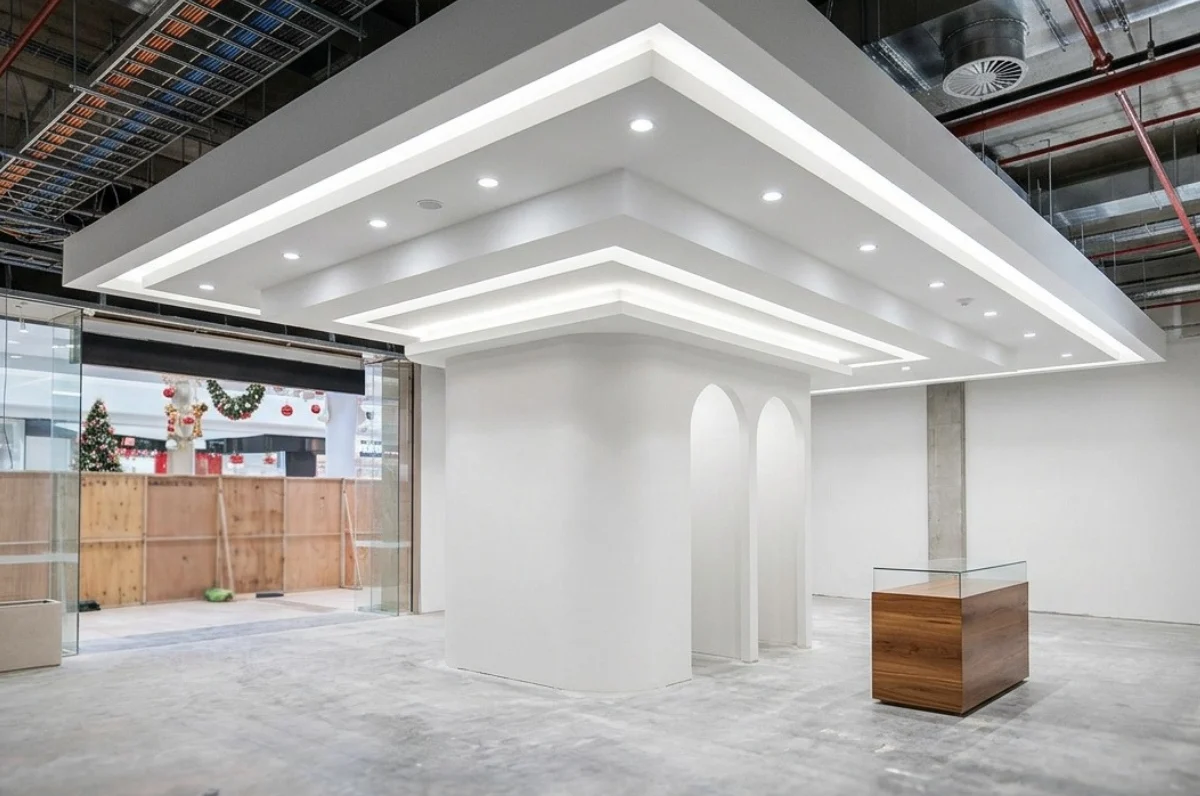
- Suspended ceilings – Concealed grid plasterboard ceilings give retail spaces a clean, level finish under bright lighting. Exposed grid ceilings suit stockrooms, back-of-house and staff areas, where access to services above matters more than looks. Either way, getting levels right at set-out saves time later.
- Bulkheads – Bulkheads frame shopfronts, hide services, carry signage and define zones within the store. They need to line up accurately with joinery, lighting and the shopfront, so careful set-out against the drawings is critical.
- Light troughs – Common in premium retail, light troughs create soft, indirect lighting. They need clean, straight lines and close coordination with the electrician.
- Partitions – Partition walls separate the sales floor from stockrooms, fitting rooms, offices and amenities. They’re often one of the first things built and one of the first things that holds up services if they run late.
- On a tight program, the key is order – Framing first, then ceilings ready for services, then sheeting, then setting and finishing. When those steps run in the right sequence, everything behind them flows.
Fire rated wall and ceiling systems, signed off to spec
Many retail tenancies need fire rated walls between tenancies, around stockrooms or in specific ceiling areas. Under deadline pressure, these are the areas where shortcuts are most tempting and most dangerous.
A fire rated system only performs as intended when it’s built exactly to the specified system. That means:
- The correct board type, thickness and number of layers
- The specified framing, spacing and fixings
- Correct junction details, head tracks and control joints
- Proper treatment around penetrations, coordinated with the trades responsible for fire sealing
On end-of-year jobs, fire rated walls also need to be ready for inspection at the right time. If a wall is closed up before it’s checked, or built off-spec, fixing it can cost days that the program simply doesn’t have.
We build fire rated systems to the drawings and specification, coordinate inspection timing with the builder, and raise any services clashes or unclear details before the wall is closed. We can also provide installation photos and records as the project requires, which helps keep sign-off moving.
Why a late plastering subbie blows the whole handover
On a normal job, a week’s delay is painful. In the pre-Christmas rush, it can wreck the entire handover.
Here’s what typically follows when plastering runs late in November or December:
- Services can’t fit off. Electricians and fire services are left waiting on ceilings.
- Painters, signage and joinery get pushed back into an even tighter window.
- The centre’s restricted period arrives before the noisy work is done.
- Stock-in and staff training get squeezed or delayed.
- The opening date slips, taking lost trading, lease costs and possible penalties with it.
- Defects get rushed, and the shop opens with problems still on the list.
And because so many fit-outs are running at the same time, there are fewer spare trades available to help claw back lost time.
That’s why the lowest plastering quote isn’t always the cheapest outcome at this time of year. A plasterer who turns up, works to program and doesn’t need chasing is worth far more than a small saving on price.
If your last plastering subcontractor cost you a week, that’s usually the whole reason someone rings us.
How we read drawings, work to program and finish clean
Our commercial work is built around one simple promise: we don’t need chasing.
Here’s how that works on an end-of-year fit-out:
1. Drawings reviewed upfront – We go through the plans, reflected ceiling plans, wall types and fire ratings before quoting, and raise questions early.
2. A realistic quote and program – Our price reflects the actual scope, and we tell you straight whether we can meet your dates before we commit.
3. Crew and materials locked in – We plan labour and order materials early to avoid end-of-year shortages and supplier shutdowns.
4. Work sequenced around other trades – Framing, ceilings, sheeting and finishing are timed to keep services and finishes moving.
5. Quality checked before handover – We check our own work under proper lighting before the builder or retailer sees it.
6. A clean site, every shift – We pack up and clean as we go, so the next trade can start straight away and neighbouring stores aren’t affected.
Booking your end-of-year fit-out plastering in Melbourne
The pre-Christmas rush leaves no room for a plastering subcontractor who runs late, misreads the drawings or leaves a mess for the next trade.
To recap:
- The end-of-year handover is fixed by trading dates, lease commencements, centre restrictions and industry shutdowns.
- Plasterers need to commit crews early, work nights and plan materials ahead.
- Suspended ceilings, bulkheads and partitions sit on the critical path and need to be sequenced properly.
- Fire rated systems must be built to spec and ready for inspection on time.
- A late plastering subbie can push back every trade behind them and cost the retailer the season.
- The right subcontractor reads the drawings, works to program and leaves the site clean.
Plaster Wizards works with shopfitters, builders and fit-out managers across Melbourne’s major shopping centres and commercial sites—including our dedicated commercial plastering team in Windsor—with crews ready for night and weekend work.
If you’ve got a fit-out that needs to open before Christmas, send through your drawings and program today, or call Nik on 0411 479 330. We’ll review the scope quickly and give you a straight answer on whether we can hit your date.








Leave A Comment